
Eloping in Abruzzo:
Italy’s Wild Mountain Heart
You want something that doesn’t look like anyone else’s wedding. No venue packages, no crowds, no posing in front of a famous landmark you’ve seen a hundred times. You want space — real, wild, breathtaking space — and two people who know exactly where to find it. Welcome to Abruzzo.
The Italy Nobody Talks About
Most couples who come to us thinking about eloping in Italy have the same shortlist: Rome, Tuscany, the Dolomites. All of them are extraordinary. We photograph there every season. But there’s a region we’ve kept coming back to — not because it showed up in a magazine, but because it keeps doing something to people that the other places don’t.
Abruzzo sits east of Rome, just two hours away, yet it feels like a different world. Here, the Italian Apennines reach their full altitude — the Gran Sasso massif, the wild plateau of Campo Imperatore, the ancient beech forests of the Parco Nazionale d’Abruzzo. No tourist buses. No posed wedding parties on every cobblestone corner. Just mountains, light, and the kind of silence that makes you realize why you wanted to elope in the first place.
This is our complete guide to eloping in Abruzzo — the locations we’ve photographed, the seasons that change everything, the logistics you actually need to know, and why this region might be the best-kept secret in Italian elopement photography. If you’re still building your shortlist, read our complete guide to eloping in Italy first.
Many of the couples we bring here combine Abruzzo with Rome — a dawn ceremony on the plateau, then a few days in the city. Two hours apart, two completely different worlds. It’s one of the most natural elopement itineraries we build, and it means your honeymoon effectively starts the moment you arrive.

The Case for Italy’s Wild Mountain Heart
I want to be direct with you about something. The most common fear I hear from couples planning an elopement in Italy is this: “We don’t want to look like everyone else.” They’ve scrolled through enough Instagram galleries to know that certain locations have a very specific aesthetic — beautiful, yes, but also recognizable in a way that can feel impersonal.
Abruzzo doesn’t have that problem. The couples who go there are the ones who chose to go there — deliberately, because they wanted something different. The plateau of Campo Imperatore is 1,800 metres above sea level, 18 kilometres long, and on any given morning you might share it with a flock of wild horses and nothing else. The beech forests of the Parco Nazionale d’Abruzzo are so ancient and protected that UNESCO lists some of them as World Heritage sites. Rocca Calascio has been used as a film set for decades precisely because it looks like no other place in Italy.
The second thing Abruzzo gives you is proximity without compromise. It’s two hours from Rome — close enough that you can combine both destinations in a single trip, different enough that the photographs will never be confused with each other. We’ve shot there in snow, in wildflower season, in the amber light of October, and in the blue haze of an early summer dawn. Each season produces photographs that look like nowhere else we’ve worked.
If you’re already coming to Italy, adding two days in Abruzzo isn’t a detour. It’s the part most couples tell us they think about most, long after the rest of the trip has faded into a general impression of beauty.
The third thing — and this is the one I didn’t expect until I first went there — is the emotional quality of the landscape itself. There’s something about high altitude, open space, and the absence of noise that changes how people hold each other. We see it in the photographs every time. It slows everything down. It makes the ceremony feel enormous.
We’ll find your perfect highland spot.
The Abruzzo Locations We Keep Coming Back To
These are the places we keep coming back to. Not because they’re famous — because of what they do to people.
Italy’s Little Tibet. A karst plateau at 1,800 metres, so wide and empty that the sky fills your entire field of vision. The light here in the first hour after dawn turns the grasslands into something between gold and silver — a colour that doesn’t have a name in English. I’ve stood at the edge of this plateau in October with a couple from California, and the only thing either of them said for the first ten minutes was nothing. That’s the Campo Imperatore effect.
Wild horses roam freely. The Gran Sasso peaks frame the northern horizon. In summer the plateau is green and vast; in winter, snow-covered and silent. Both are extraordinary.
↳ Best time: Late May–June for wildflowers · September–October for amber light · January–February for snow
The highest peak in the Apennines. Not every couple wants to stand on a summit — but for the ones who do, nothing in central Italy comes close to this. The ridgelines below the Corno Grande offer accessible positions with vertiginous drops, towering rock faces, and the kind of scale that makes two people look simultaneously tiny and completely right together.
The glacier below the peak — the southernmost in Europe — adds something ancient to the view. The park itself is part of the Gran Sasso and Monti della Laga National Park, one of the largest protected areas in central Italy. Snow remains on the upper slopes well into June, making late spring shoots here particularly striking.
↳ Best time: June–September (accessible) · Snow conditions: November–May on upper sections
Few people outside Italy know this plateau exists. The Altopiano delle Rocche sits in the heart of the Sirente-Velino Regional Park at around 1,300 metres — a wide, open highland with medieval villages at its edges, surrounded by mountains on every side. In late May, the entire plateau explodes with narcissus flowers. It’s one of the most quietly spectacular landscapes in Italy, and almost no anglophone couples have photographed there.
The villages of Rocca di Mezzo and Rocca di Cambio — the highest municipality in the Apennines — sit at the plateau’s edge and add architectural texture to landscape shoots.
↳ Best time: Late May (narcissus bloom) · September–October for autumn colour

A medieval fortress at 1,460 metres, overlooking Campo Imperatore from the south. The castle has appeared in international films — Ladyhawke, The Name of the Rose, The American with George Clooney — because it looks like a set designer’s dream of what a mountaintop ruin should be. Except it’s real, and it’s been standing there since the 10th century. Below the fortress, the tiny round church of Santa Maria della Pietà sits in a natural bowl of the mountain, offering ceremony spaces that look completely impossible.
At dusk, the fortress catches the last light while the valleys below sink into shadow. It’s one of the most visually singular locations in all of Italy.
↳ Best time: Golden hour year-round · Snowfall (December–March) transforms the whole scene
There’s a lake in the Parco Nazionale d’Abruzzo shaped like a heart. Not a perfect, graphic heart — a natural one, traced by a landslide thousands of years ago. From the road above, where the mountain bends south toward Scanno, you see the whole thing at once: water, beech forest, peaks. The light in autumn, when the trees turn, is the kind that makes every frame feel like it was composed by hand.
The village of Scanno sits above the water and has been drawing photographers for over a century — Henri Cartier-Bresson came here in the 1950s. The winding medieval streets work beautifully for portrait sequences between wider landscape shots.
↳ Best time: Late September–October for beech foliage · Early morning for still reflections
The Piani di Pezza are what Campo Imperatore might have looked like before anyone knew it existed. A glacial sub-plateau at 1,500 metres, barely reachable, surrounded by the Velino mountain group, with views back across the entire Sirente-Velino chain. No tourist infrastructure. No marked trails for mass walking groups. Just the mountain, the light, and a landscape that changes colour with every hour of the day.
Access requires a short approach on foot or a narrow unpaved road (passable by car in summer). For couples who want maximum isolation, this is our strongest recommendation in the region.
↳ Best time: June–September · Avoid November–April (road conditions)

You walk into Camosciara and the mountain closes around you. Beech trees — some over 400 years old, UNESCO-listed, as old as the oldest buildings in Rome — filter the light into long vertical shafts. In autumn the forest floor is copper and gold. The Apennine chamois lives on the rocky slopes above the treeline; on a quiet morning you might find them moving just above you.
This is the location we recommend for couples who want to be inside the landscape rather than above it. Not a plateau, not a fortress — a forest that has been standing since before anyone thought to photograph it.
↳ Best time: Late September–October for colour · May–June for green canopy light
You walk into the valley and the mountain closes around you. The Valle dell’Orfento is a deep river canyon cut into the Majella massif — waterfalls, ancient hermitages carved directly into the rock face, a beech forest that begins at the canyon rim and descends into shadow. It’s vertical and enclosed in a way that none of the plateaus are, and it produces photographs with a completely different emotional register.
For couples who want both intimacy and scale in a single location — the canyon draws you in, the mountain walls frame you from above. It’s unlike anything else we shoot in Abruzzo.
↳ Best time: May–June for waterfalls · October for foliage against the limestone rock
The Local Truth
Everyone who comes to Abruzzo for the first time asks us the same question afterward: “Why doesn’t anyone know about this place?” The honest answer is that it takes a certain kind of couple to choose it — one that isn’t looking for validation from a recognizable name.
Campo Imperatore doesn’t appear on the shortlists because it requires a willingness to go somewhere unfamiliar. That same quality is what makes the photographs there unlike anything we’ve made anywhere else. The couples who choose Abruzzo tend to already know who they are. The mountains just make it visible.
Tell Us Your Story →
Dawn vs Golden Hour in Abruzzo
Two windows. Completely different photographs. Neither is wrong — but they’re not interchangeable.
· Dawn — First Light
At Campo Imperatore, dawn means arriving in darkness and watching the plateau emerge. The light at 5:30am in September is not warm — it’s cool, silver, almost blue, and it makes the Gran Sasso look like something from another planet. The mist sits low on the grasslands. Wild horses may appear. For fifteen to twenty minutes, the plateau belongs to you completely.
Best for: wide landscape shots · atmospheric, cinematic mood · eerie, otherworldly quality
· Golden Hour — Sunset
In Abruzzo, golden hour in autumn turns the highland grasslands amber. At Rocca Calascio, the fortress catches the last light while the valleys below disappear into blue shadow — the contrast is extraordinary. At Campo Imperatore, the same plateau that was silver at dawn becomes warm, raking, cinematic. Two very different photographs from the same place, twelve hours apart.
Best for: golden warmth · portrait sequences · Rocca Calascio silhouette shots · couple-in-landscape
A Real Story — Campo Imperatore & Santo Stefano di Sessanio
They’d been planning a bigger wedding for two years when they finally decided to let it go. Not because of the pandemic, though that was the catalyst — but because they realized the version of the day they’d been imagining was never really theirs. They booked two nights at Sextantio in Santo Stefano di Sessanio and woke before dawn on their elopement day to drive up to the plateau.
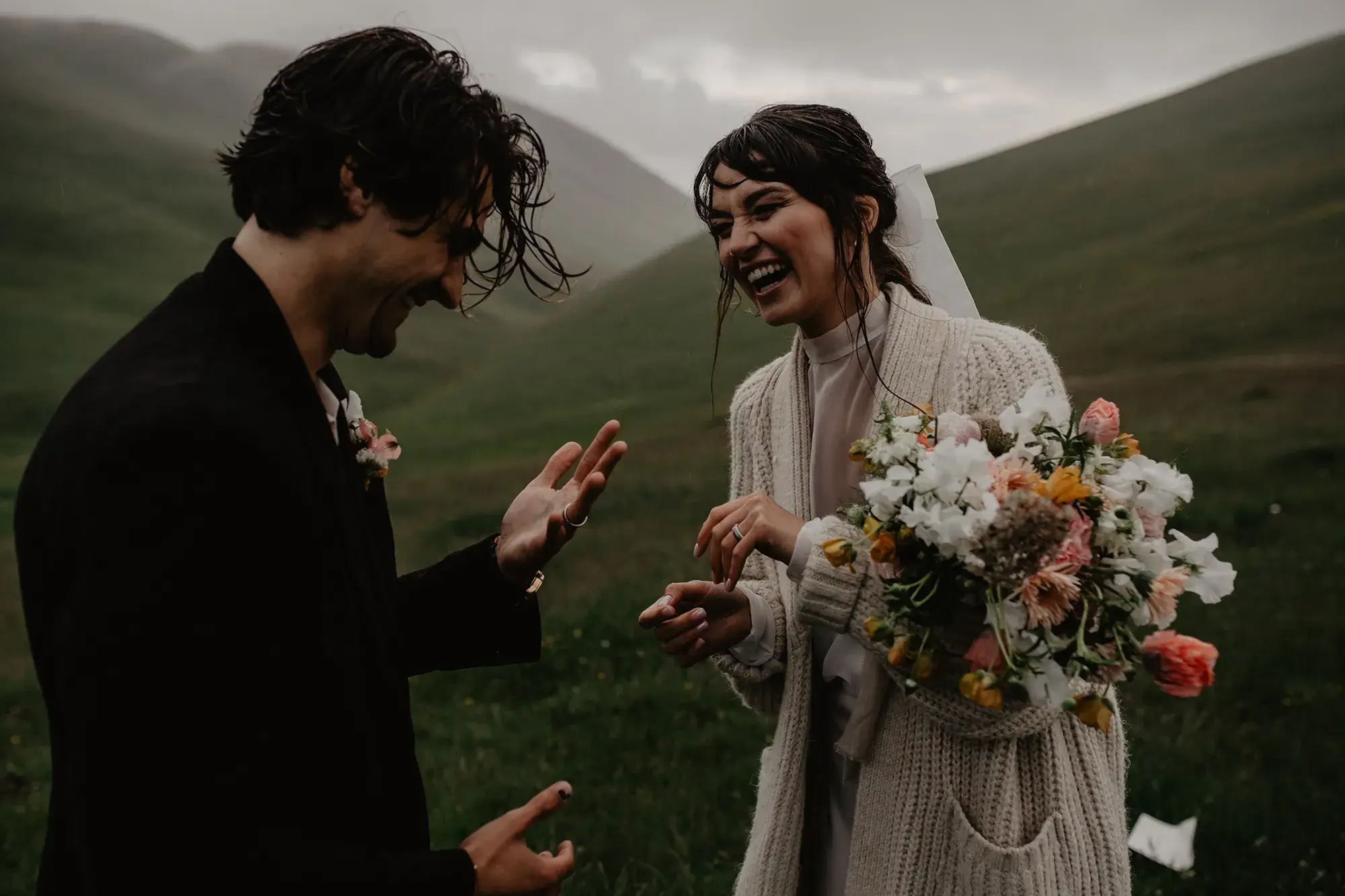
I remember the moment they stepped out of the car. It was 5:40am and Campo Imperatore was still dark at the edges. She turned to him and said something I couldn’t hear. He laughed. That was the first photograph.
By midday, they were married. On a plateau that looks like nowhere else on earth. Over breakfast at Sextantio, neither of them said very much — and that felt exactly right.
This elopement was featured on Junebug Weddings.


← scroll to explore →
When to Elope in Abruzzo: Season by Season
Abruzzo’s mountain terrain means seasonal differences are dramatic — not cosmetic. Each season produces a completely different visual landscape and a different logistical reality.
— Spring — April / May / June
The highland plateaus turn green in May. The narcissus bloom on the Altopiano delle Rocche in late May is one of the most underrated natural events in Italy. Waterfalls are at full flow in the Majella gorges. Light is long and clear.
- Wildflower bloom on the plateaus
- Long golden hours, clear light
- Valle dell’Orfento waterfalls at peak
- April can be unpredictable, snow possible at altitude
- June gets busy on lower valley trails
— Summer — July / August
At altitude, summer is comfortable and cool — while the valleys below bake. Campo Imperatore remains green and wild. The light is intense, the sky dramatic, afternoon storms build fast. Ideal for couples comfortable with variable conditions.
- Comfortable temperatures at 1800m+
- Dramatic thunderstorm light (controllable with planning)
- All access roads fully open
- Busiest season for Italian domestic tourism
- Midday light is harsh — early morning essential
— Autumn — September / October
The best season for light. The beech forests of the Parco Nazionale d’Abruzzo turn from green to gold in October and the plateau grasslands become amber in September. The light is long, warm, and low — the plateau photographs at their absolute peak.
- Best light of the year — warm and low
- Beech forest colour at full peak (October)
- Empty plateaus, no crowds
- Weather becomes less predictable from late October
- Mountain roads require weather awareness
— Winter — November / February
Snow transforms Campo Imperatore and Rocca Calascio completely. The fortress in winter looks like a scene from a Northern European fairy tale, set in the Italian Apennines. Cold, but not prohibitive — and entirely empty of other people.
- Snow-covered plateau and fortress — extraordinary visual
- Absolute solitude
- Strong graphic contrast in the photographs
- Some mountain roads close without notice
- Ceremony must be timed around daylight window (short)
“We went in October and the light did something to us that we still can’t explain. The photographs don’t look like anyone else’s. We walk past them every day and they still stop us.”
A Perfect Abruzzo Elopement Day
This is the itinerary we’d build for a couple based at Sextantio in Santo Stefano di Sessanio, combining Campo Imperatore at dawn with a late afternoon shoot at Rocca Calascio. Adjust for your season and preferred pace.

Making a Full Experience of Abruzzo
An elopement day in Abruzzo doesn’t begin and end with the ceremony. The region rewards time.
Sextantio Albergo Diffuso
Santo Stefano di Sessanio is a medieval village at 1,251 metres, and Sextantio Albergo Diffuso is unlike any other place to sleep in it. Not a hotel in the traditional sense — a carefully restored diffuse residence spread through the ancient stone buildings of the village. We’ve photographed two couples here and it remains one of our strongest recommendations anywhere in Italy. The silence at night, the stone walls, the altitude, the absence of anything modern — it creates a specific mood that carries through into the elopement day.
Super8 Film in the Mountains
We offer Super8 film as an add-on for every elopement — and the Abruzzo landscape was made for it. The grain, the warmth, the imperfect edges of film photography suit the plateau and the ancient light of the Gran Sasso in a way that digital alone doesn’t fully capture. Couples who add Super8 here often tell us it’s the footage they watch most.
Rome to Abruzzo — Two Days
Abruzzo sits two hours from Rome. For couples considering Italy for the first time, we regularly design two-day experiences: a first shoot in Rome at dawn (the city before anyone is awake), followed by a drive to Abruzzo for the mountain ceremony. The contrast between urban and wilderness is total. It’s one of our favourite itineraries to plan.
The Food & the Silence
Abruzzo has a food culture built around altitude — lamb from the plateau, lentils from the high plains, pasta alla chitarra made the way it’s been made in L’Aquila for centuries. After a dawn ceremony on Campo Imperatore, sitting down to breakfast in a stone village with local cheese and mountain honey is the correct way to spend the morning. We’ll tell you exactly where to go.


Ceremony Options in Abruzzo
Legal Ceremony
A legally binding ceremony in Abruzzo requires coordination with the local municipality (Comune) and apostilled documents from your home country. The ceremony must be conducted by a civil registrar in a designated location — the Comune office or, in some cases, an outdoor setting approved by the municipality.
- Legally recognized in your home country (with proper paperwork)
- Requires 2–3 months of advance preparation minimum
- Documents: birth certificates, Certificate of No Impediment (apostilled)
- Ceremony usually 20–40 minutes, in Italian
- Translation required for non-Italian couples
Symbolic Ceremony
A symbolic ceremony is entirely yours: no paperwork, no bureaucracy, no restrictions on location or format. You write your own vows. You choose where you stand. You choose who officiates — or you say them to each other alone on a highland plateau at dawn. Most couples who elope in Abruzzo choose this option because it gives them the ceremony they actually wanted without compromise.
- No paperwork required — plan as early or late as you like
- Any outdoor location — plateau, forest, fortress, valley
- Full freedom over vows, format, and officiants
- Can be combined with legal ceremony in home country before or after
- Photographically: often more natural and emotional
- The only available option for LGBTQ+ couples — same-sex marriage is not yet legally recognized in Italy

Getting There — The Only Logistics You Need
Arriving in Italy
The closest major international airport to Abruzzo is Rome Fiumicino (FCO). From Fiumicino to the Gran Sasso area is approximately 2 hours by car. Pescara Airport (PSR) serves some European routes and is closer to the eastern Abruzzo valleys — worth checking if you’re coming from the UK or Northern Europe.
Getting Around
A rental car is essential for elopements in Abruzzo. The mountain locations — Campo Imperatore, Rocca Calascio, the national park valleys — are not accessible by public transport. We always recommend renting from Rome before driving up, rather than from Pescara, as the western approach to the Gran Sasso is more scenic and direct for most itineraries. Roads are well-maintained in summer and autumn; winter requires weather checks.
Permits & Access
Most outdoor locations in Abruzzo’s mountains do not require permits for intimate elopement groups (1–8 people). Certain restricted zones within the Parco Nazionale d’Abruzzo require prior authorization from the park administration. Rocca Calascio has a small access fee for the fortress itself. We research and handle all access logistics for every elopement we plan — you don’t need to navigate this yourself.
Where to Stay
We almost always recommend staying at Sextantio Albergo Diffuso in Santo Stefano di Sessanio — it’s the ideal base for Campo Imperatore and Rocca Calascio, and the experience of the place is worth the trip on its own. For the Parco Nazionale d’Abruzzo area, Pescasseroli and Civitella Alfedena offer excellent small hotels and agriturismi. We provide accommodation recommendations for every inquiry.

Emanuele & Federica — We Live Here
We’re a couple — seventeen years together, both born and raised in Rome, both convinced that the best photographs happen when nobody is performing. I photograph; Federica plans, coordinates, and builds the whole experience around you.
In practice, what that means on an Abruzzo day: while I’m reading the light at Campo Imperatore before dawn, Federica is the one who arranged your wildflower bouquet from a florist in L’Aquila the day before, who packed the picnic basket for the plateau — local cheese, mountain honey, a bottle of something cold — and who timed the drive from Sextantio so you arrive in darkness and step out just as the Gran Sasso catches the first light. The ceremony takes eleven minutes. The picnic on the plateau afterward can last as long as you want.
We handle the whole day — logistics, celebrant coordination, florals, timing, backup plans for weather. You handle nothing except showing up and being present with each other. Our style is documentary — we don’t pose, we don’t direct. We find the light, we put you in it, and we stay close enough to catch what happens. The word we want you to use when you look at your photographs is recognizable. Not beautiful, not cinematic — though we’ll take both. Just: that’s so us.
“From the very first message, everything felt easy, fun, and professional. They know exactly where to be, when to move, when to stay still. We trusted them completely — and the photographs are everything we hoped for.”
What an Abruzzo Elopement Costs
All collections include full planning guidance, location scouting, permit handling, and travel within Italy.
| What’s Included | Notes | Approx. Cost |
|---|---|---|
| Photography collection | Full elopement day, edited gallery, licence | From €5,500 |
| Travel — In Bianco e Nero | Included. No surcharge for Abruzzo. | €0 |
| Location scouting & permits | Included in all collections | €0 |
| Super8 film add-on | Highly recommended for Abruzzo | On request |
| Symbolic ceremony officiant | We can recommend trusted celebrants | €400–€800 est. |
| Sextantio Albergo Diffuso | Santo Stefano di Sessanio — recommended stay | €200–€400/night est. |
| Rental car (Rome) | Essential for mountain access | €60–€120/day est. |
| Flowers / styling | Optional — we work with trusted florists | €200–€600 est. |
For full package details and current availability, visit our packages and pricing page.
It’s the only way every story gets the attention it deserves.
Frequently Asked Questions

We wrote the guide.
Everything from choosing a location to handling family, legal vs symbolic in plain language, and building a day that actually feels like you. Written by people who live in Italy and have guided over 200 elopements.
No spam · Unsubscribe anytime

You’ve felt the pull.
Let’s make it happen.
Tell us your dream date, your dream mountain — or just that you’re not sure yet. We’ll figure it out together, over a coffee or a voice note from wherever you are.
Tell Us Your Story →No commitment · Free consultation · 30 couples per year
Still planning? These might help.


& Federica
Rome-based elopement photographers. We live here, we know every plateau and every light. We guide a maximum of 30 couples per year — by design.